
Tour review · TOUR REVIEWS
Diving in the Mexican Caribbean for Beginners | 2 Tanks 2 Dives | All Inclusive
That first breath underwater changes everything.
This beginner-friendly Cancun course pairs hands-on prep with two real underwater sessions in the Caribbean, including the famous MUSA underwater museum plus a natural reef. I love that it’s built around confidence, not just rules, and that the day runs like a smooth checklist from marina to boat to water. One thing to keep in mind: this experience is not for you if you have asthma, have had recent flying plans, or you’re not a capable swimmer.
What I like most is the safety-first training rhythm: a clear theory session, then pool practice before you ever go in the ocean. Second, I appreciate the small-group setup, with a maximum of 6 people, so the guide can stay close and help you troubleshoot as you learn. For most beginners, that close attention is the difference between feeling rushed and feeling ready.
The main drawback is simple, and it’s not the tour’s fault. Expect a full morning through midday with boat time, plus optional costs for photos and possibly a wetsuit rental. If you get motion sick easily, the boat ride could be a factor too.
Key highlights you will feel immediately
- Pool practice before the ocean: you rehearse mask clearing, breathing, and basic underwater skills in a controlled setting
- Small group max of 6: you get more time with the guide, not just quick instructions
- Two underwater sessions on two tanks: one at MUSA and one on a natural reef
- MUSA at about 33 ft / 10 m: you’re learning in the right conditions, not some chaotic deep-water jump
- Guide names to watch for: Clemente, Clementine, Lorainna, and Isabel show up often in feedback for patience and clear guidance
- Plan for the photo add-on: many people budget roughly $70 to $85 for the optional photo package
From the hotel zone to the marina, step one is getting geared
The day starts at Pescador on Kukulcan Boulevard in Cancun’s Zona Hotelera, with an 8:00 am start. You meet at the marina area, and from there the whole routine moves quickly, in the good way. The crew helps you get fitted with full scuba equipment based on your size, so you are not stuck guessing what to wear or how everything should feel.
One of the smartest parts of the setup is that you are not left hungry. You have bottled water, juices, and snacks available before you head out, and that matters because learning scuba is physical work. Even if you consider yourself calm, your body is still adjusting to gear weight, buoyancy basics, and a new breathing pattern.
You will also want to take the swim requirement seriously. The experience explicitly says you need to know how to swim, and you should treat that as a hard check, not a suggestion. If you are shaky in open water, you will feel it during training.
You can also read our reviews of more scuba diving tours in Cancun
Safety and communication: the theory that keeps you calm
Before any ocean time, you get a 35-minute theory session. This is where the guide runs through how the equipment works, how you communicate underwater using hand signals, and how your body behaves with the scuba system.
The best part of this kind of briefing is not memorizing facts. It is the way it reduces surprises. When you know what the most common moments feel like, you stop spending your brainpower on panic. For a beginner, that is huge.
You also focus on technique and safety. The instruction includes priorities and how the group will manage the experience. In feedback, Clemente and Clementine are repeatedly described as patient and clear, and that matches the vibe you want for the first time you step into this world.
Pool practice: why your first breaths feel so much easier later
After theory, you move straight into pool training. The pool session is designed to match what you’ll do in the ocean later, so it is not just show-and-tell. You practice the core motions and breathing rhythm in a place where the ground is right there if you need it.
If you have ever tried something new and realized your brain panicked because your body did not know the sequence yet, this is the fix. The pool time helps your hands and your breathing pattern sync up. It also gives you a chance to ask questions before the saltwater environment adds extra complexity.
In real beginner feedback, people keep calling out how patient the instructors are during this stage, including support when someone struggles with comfort or gear. That lines up with why a pool session matters: it lowers the learning curve, so you spend your ocean time looking at fish instead of fiddling.
The boat ride: short, timed, and worth respecting
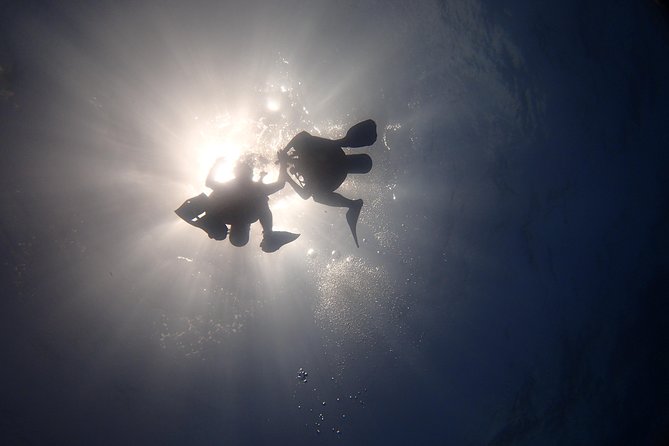
Once the pool and gear setup are done, you board a boat and head to the descent area. The boat trip is about 30 minutes one way.
This part is straightforward, but it matters for two reasons. First, it builds anticipation, which is fun. Second, it is real open-water motion. One person in feedback mentioned sea sickness and being unable to finish the last portion of the day. If that is a concern for you, take it seriously. Plan to eat lightly, stay hydrated, and let the crew know if you start feeling off.
The boat crew is described as attentive, and people also mention the boat itself as big and comfortable. Still, you are on the water, so treat it like a boat ride, not a ferry you barely feel.
First underwater session at MUSA: 400 sculptures and controlled conditions
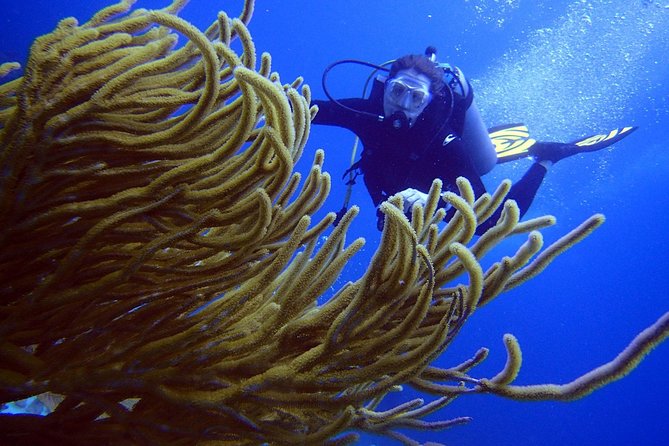
At the descent site, you tie yourself to buoys for entry and guidance down. This keeps things orderly, and it helps beginners manage the transition from boat to open water.
Your first underwater session is about 35 minutes and at a depth around 33 ft / 10 m. That specific depth is a big deal for beginners. It gives you the full scuba experience without jumping straight into deep conditions on day one.
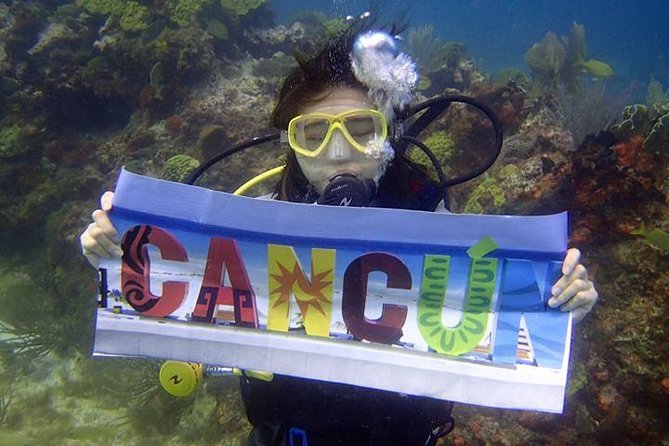
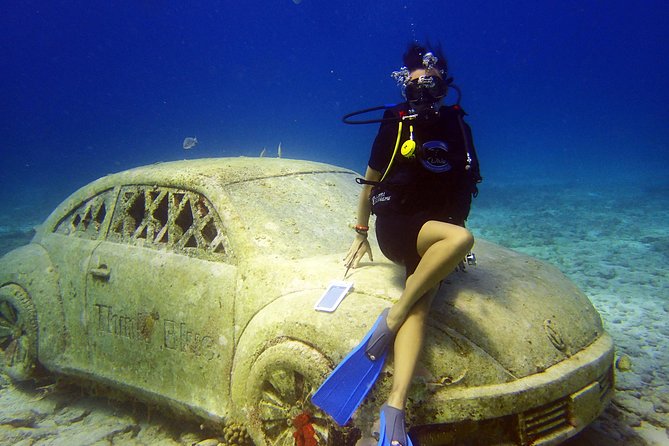
This first stop is at the Museo Subacuatico de Arte (MUSA), the underwater museum. The big draw is the scale, with about 400 underwater sculptures. Expect the feeling of exploring an art gallery, but the gallery is filled with schools of fish and shifting light from the surface.
Also, the museum concept changes how you look underwater. You’re not just scanning for coral and animals. You are also navigating shapes and statues, which gives your mind something interesting to focus on.
One practical note: the museum is not the same as a sandy-bottom beach. You’ll likely want to keep your buoyancy steady and avoid touching anything. The crew guidance here is key, since learning your buoyancy is part of the lesson.



Second underwater session on a natural reef: more life, more variety
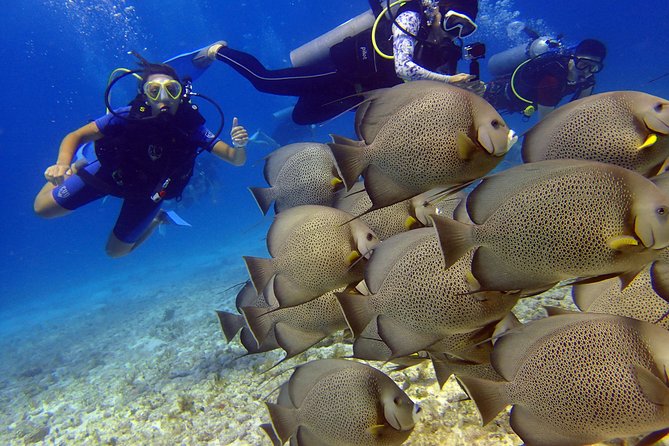
After the museum, you move to the second site, a natural reef. This second underwater session is also about 35 minutes.
This stop is where many beginners feel the Caribbean payoff: more movement, more wildlife variety, and a sense of freedom once you’re past the first learning curve. In feedback, people often call the reef the stronger experience compared to the museum, mainly because you spend more time watching marine life rather than reading the underwater art.
Expect tropical fish and different marine life along the reef. If you have watched underwater videos but never lived it in person, this is where it hits. The water has a way of making everything feel lighter, and the buoyancy effect can be strangely relaxing.
Depth control and comfort still matter here, even though it feels more natural than the museum. Your guide stays focused on your status and comfort, and that is exactly what you want after learning the basics on the first stop.
What two tanks and two sessions really mean for you
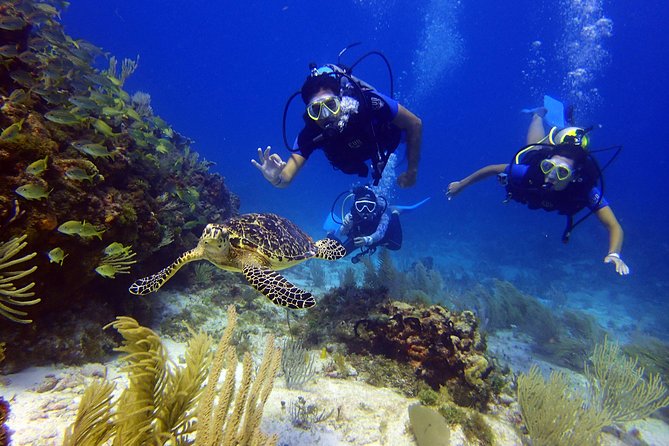
At first glance, two tanks might sound like you are paying for extra time underwater. In reality, it is better than that. Two underwater sessions give you a “learning loop.”
- Session one helps you get your breathing, buoyancy, and hand signals sorted.
- Session two lets you use those skills with more confidence.
That second chance is valuable, especially because the training is only part of the day. You also need mental time to reset between sites, which you get through the boat ride and surface intervals.
For beginners, the benefit is confidence. For returning divers, the benefit is pacing. Either way, the structure keeps you from feeling like you only had one shot and blew it.
Small-group attention: how you get help without feeling rushed
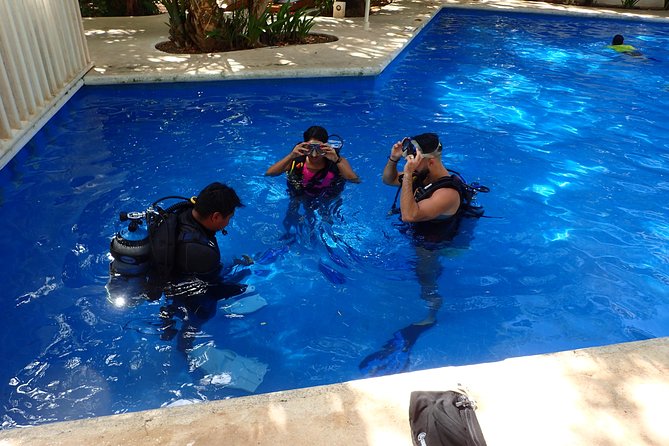
This experience caps at 6 travelers, and that changes everything about how instruction feels. With a larger group, you often wait. With a smaller group, you get corrections in real time.
In feedback, people repeatedly describe Clemente and Clementine as patient and attentive, including help with gear and reassurance when someone feels nervous. That is a big deal. Scuba is not only about breathing equipment correctly. It is also about staying calm while your body adjusts to being weightless.
If you like an instructor who stays close, checks your status regularly, and helps you navigate the water smoothly, you will probably love this format.
Gear, snacks, and the little costs that can catch you
The price is $190.69 per person for an approximately 6-hour experience. When you compare it to how much training and equipment time you get, it starts to make sense. You’re not just buying ocean time. You are buying equipment, instruction, and guided underwater work, plus the transport by boat to the sites.
Included basics:
- Use of scuba equipment and all equipment needed
- Snacks: cookies and fruit, plus bottled water or juice
- All fees and taxes
- Big, fast, comfortable boats
- Top quality facilities
Not included:
- Wetsuit if needed
- Transportation between your hotel and the facility
And in practical terms, people often plan extra money for photos. Reviews suggest budgeting around $70 to $85 for the photo package. One person also mentioned wetsuit rental around $10. These are add-ons, not requirements, but if you want the memory capture, you’ll want to decide ahead of time.
Who this is best for in Cancun
This is designed for people who want to try scuba with strong beginner support. The pool training and the structured, safety-first theory session make it a good entry point if you have never done it before.
It also fits couples and small groups who want personalized attention. A lot of feedback praises how the guide stayed with people throughout the entry, descent, and return, and that is especially helpful if you tend to get anxious in new activities.
You should not book if you:
- do not meet the swim requirement
- have asthma
- have uncontrolled or controlled high blood pressure
- have respiratory problems
- plan to fly within the next 24 hours
Quick practical tips so your day goes smoother
- Arrive ready to swim and move. Your physical comfort affects how fast you learn buoyancy.
- Bring or arrange hotel transportation. The tour does not include travel between your hotel and the dive facility.
- If you think you might get motion sick, plan for that boat ride. Mention it early to the crew.
- Decide in advance about photos. If you want them, budget for the common $70 to $85 range mentioned in feedback.
- Plan your day around an 8:00 am start. This is not a quick afternoon activity.
Should you book this beginner scuba course?
Yes, if you want a structured first scuba experience with pool practice, strong safety focus, and a small group. I’d especially recommend it if you’re drawn to the MUSA museum’s underwater sculptures and you also want a natural reef session to balance the art with marine life.
Skip it if the swim requirement is hard for you, if you have asthma or respiratory issues, or if you are likely to struggle with open-water boat motion. Also, if you hate long mornings or prefer super light schedules, this one might feel like a lot because it’s about a full 6-hour block.
If you match the basics, this is a smart first step into the underwater world, with the kind of patience and guidance that beginners really need.
More Scuba Diving Tours in Cancun
More Tour Reviews in Cancun
Not for you? Here's more nearby things to do in Cancun we have reviewed







Tour Reviews, compared.
 ★ 5.0Chichen Itza, Cenote, and Valladolid TourFrom $4524,293 reviews
 ★ 4.5Chichen Itza, Cenote & Valladolid Tour with Tequila and LunchFrom $3415,789 reviews
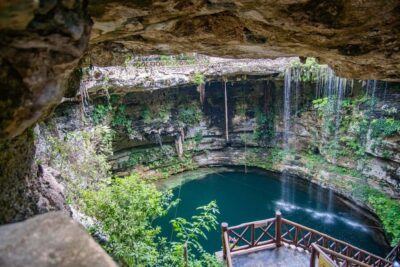 ★ 4.6Chichen Itza, Cenote & Valladolid Tour with LunchFrom $496,722 reviews
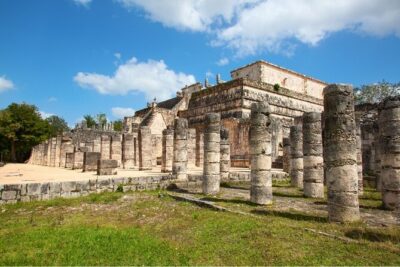 ★ 5.0Early morning Chichen Itza Tour: Cenote and Tequila TastingFrom $266,657 reviews
 ★ 5.0Private Roundtrip Transportation from Cancun Airport to Cancun Hotel ZoneFrom $945,086 reviews
 ★ 4.5Cancun ATV Jungle Adventure, Ziplines, Cenote and Tequila TastingFrom $494,873 reviews
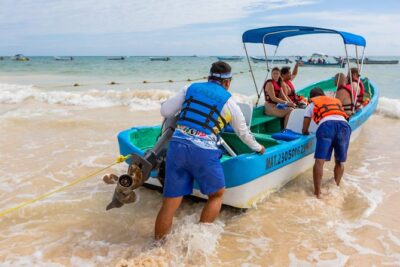 ★ 5.0Viator Exclusive: Tulum Ruins, Reef Snorkeling, Cenote and CavesFrom $1294,242 reviews
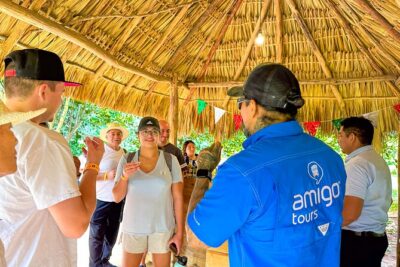 ★ 4.5Chichen Itza Early Access All Inclusive: Hotel Pick up & All FeesFrom $1654,123 reviews
Browse the lists this tour appears in